


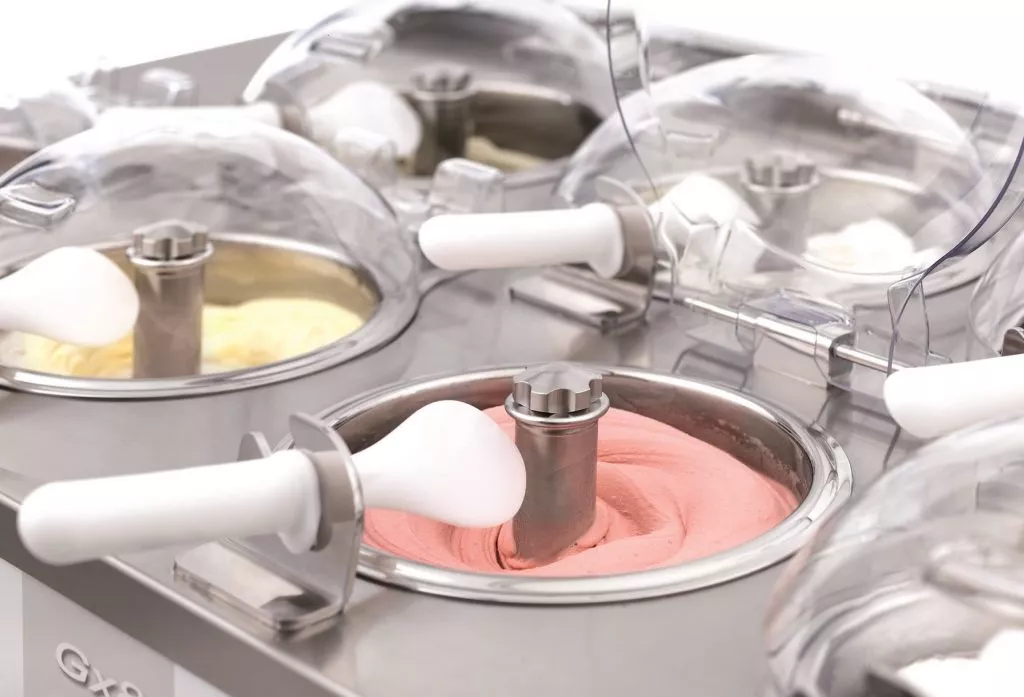


R290 and the New Frigomat Batch Freezers: Why Refrigerant Choice Matters
When choosing a new batch freezer, most businesses naturally focus on production capacity, consistency, ease of use and reliability.
Increasingly, however, there is another consideration: what refrigerant is inside the machine?
The latest generation of Frigomat TITAN and G-Series batch freezers uses R290 natural refrigerant, marking an important step in the development of the range.
It might sound like a relatively small technical change, but refrigerant choice is becoming increasingly important as the foodservice and refrigeration industries move away from higher Global Warming Potential refrigerants and F-Gas legislation continues to reduce the use of hydrofluorocarbons, or HFCs.
For anyone investing in new gelato equipment today, it is worth understanding why that matters.
What is R290?
R290 is the refrigeration industry designation for propane, a naturally occurring hydrocarbon that can be used as a refrigerant.
Unlike the HFC refrigerants traditionally found in a wide range of commercial refrigeration equipment, R290 is not a fluorinated greenhouse gas.
One of its most important environmental characteristics is its very low Global Warming Potential, or GWP.
GWP is essentially a way of comparing the potential climate impact of different greenhouse gases. Many traditional HFC refrigerants have GWPs measured in the hundreds or thousands. R290 is dramatically lower: the US Environmental Protection Agency, for example, lists R290 with a GWP of around 3, compared with 1,430 for R134a and 3,922 for R404A using the same reference methodology.
That difference becomes particularly important if refrigerant is ever released from a system during its lifetime, servicing or eventual disposal.
Why are F-Gases becoming such an important issue?
F-Gases are a group of manufactured gases that include HFC refrigerants.
They became widely used because they provided effective alternatives to older ozone-depleting refrigerants. The problem is that many HFCs are themselves powerful greenhouse gases.
The UK Government describes HFCs as having global warming potentials considerably greater than carbon dioxide, and they continue to represent the largest proportion of UK F-Gas emissions.
F-Gas regulations have therefore been designed to progressively reduce the amount of HFC refrigerant entering the market.
This is not simply a future ambition. The phase-down is already well underway.
The F-Gas phase-down in Great Britain
In Great Britain — England, Scotland and Wales — the existing F-Gas regime places progressively tighter limits on how much HFC refrigerant can be placed on the market.
Under the current schedule, the quota falls from 31% of the baseline during 2024–2026 to 24% during 2027–2029, before reaching 21% in 2030. That represents a 79% reduction against the regulatory baseline.
The Government has also been considering going considerably further.
A consultation launched in November 2025 proposed extending and strengthening the phase-down, potentially moving towards a 98.6% reduction by 2048. In May 2026, the Government confirmed that it would not change the existing 2027 step during 2026 while further work is undertaken, but also reiterated its intention to pursue more ambitious HFC reform.
So while the precise future timetable is still developing, the overall direction is clear: the availability and use of higher-GWP HFC refrigerants is expected to continue reducing.
Northern Ireland is already operating under newer EU rules
There is an additional consideration for businesses operating across the whole of the UK.
Under the Windsor Framework, Northern Ireland continues to apply EU F-Gas legislation. The EU introduced a new F-Gas Regulation in 2024, which applies directly in Northern Ireland.
That legislation introduces a substantially more aggressive HFC phase-down, ultimately moving towards a complete HFC phase-out by 2050, alongside tighter restrictions on fluorinated refrigerants in new equipment.
Great Britain and Northern Ireland therefore currently operate under different F-Gas regimes, but both point towards the same broader trend: lower reliance on high-GWP fluorinated refrigerants and increased use of alternatives where technically appropriate.
Where does R290 fit into this?
This is where Frigomat’s move to R290 becomes significant.
Because R290 is a hydrocarbon rather than an HFC, it is not part of the HFC quota phase-down that is progressively restricting the amount of these fluorinated gases entering the market.
For an equipment manufacturer, moving to R290 therefore means adopting a refrigerant technology that is much better aligned with the direction refrigeration regulation is taking.
And for an operator investing in equipment expected to remain in service for many years, that is an increasingly relevant consideration.
It does not mean that older refrigerants will suddenly disappear or that existing equipment immediately becomes obsolete. F-Gas legislation contains detailed rules covering existing equipment, servicing and different applications.
But when purchasing new equipment, choosing technology that already uses a very low-GWP refrigerant can help reduce exposure to the ongoing transition away from traditional HFCs.
R290 across the new Frigomat range
Frigomat has incorporated R290 natural refrigerant into its latest generation of professional batch freezers.
That includes the new TITAN horizontal batch freezer range, from the compact TITAN 20 through to the high-capacity TITAN 100, as well as the new G-Series vertical batch freezers. The specifications for the new machines identify R290 alongside their high-efficiency refrigeration systems.
It means operators can select a machine according to their production requirements without the environmental refrigerant choice being restricted to one particular size or model.
Sustainability is about more than one specification
It is important not to overstate what a refrigerant change means.
Using R290 does not automatically make any piece of equipment completely “green”. The overall environmental impact of commercial equipment also depends on factors such as its energy consumption, operating life, maintenance, manufacturing and eventual disposal.
Refrigerant choice is, however, an important part of that picture.
Using a refrigerant with a dramatically lower GWP reduces the potential direct climate impact associated with refrigerant leakage and moves the equipment away from the HFC gases that F-Gas regulations are specifically designed to phase down.
The new Frigomat machines also incorporate inverter technology and high-efficiency refrigeration systems, so refrigerant choice forms part of a broader update to the range rather than standing alone.
Making a longer-term equipment decision
Commercial batch freezers are capital investments. A business purchasing one today will reasonably expect it to remain part of its operation for many years.
That makes it sensible to consider not only what the machine can do today, but how well its technology fits with where the industry is heading.
The continuing F-Gas phase-down is putting increasing emphasis on lower-GWP refrigerants. Regulations in Great Britain are already reducing HFC availability, further reform is being considered, and Northern Ireland is already operating under the EU’s more aggressive 2024 F-Gas Regulation.
Against that background, Frigomat’s adoption of R290 natural refrigerant across its latest batch freezers is more than a change on a specification sheet.
It is a move towards a refrigerant with a far lower climate impact and one that sits outside the HFC phase-down.
Discover the new Frigomat batch freezer range
From compact production through to high-volume professional gelato operations, the latest Frigomat TITAN and G-Series batch freezers combine a new generation of machine controls and production technology with R290 natural refrigerant.
If you are planning a new gelato operation, replacing an existing batch freezer or simply want to understand what the changing F-Gas landscape could mean for your next equipment purchase, talk to Taylor UK.
We can help you compare the new Frigomat models and identify the right machine for your production requirements.
Talk to Taylor UK about the new Frigomat TITAN and G-Series batch freezers, or book a gelato demonstration to see the machines in action.
Call the Taylor UK Team on 0800 838 896